
What is Breadcrumbing?
What is Breadcrumbing?
Understanding the Subtle Manipulation
That Keeps You Stuck
You don’t feel fully chosen, but you also don’t feel fully let go. He texts just enough to stay in your life and checks in when you start pulling away.
He gives you hope, but never consistency. Somehow, you’re left feeling confused, anxious, and questioning yourself.
If that feels familiar, you may be experiencing something called breadcrumbing Let’s talk about it honestly, because once you see it clearly, it becomes a lot harder to accept.
What Is Breadcrumbing?
The definition of breadcrumbing is a pattern where someone gives you small amounts of attention, affection, or communication—just enough to keep you interested, but never enough to build a real relationship.
Think of it like emotional crumbs. Not a full meal, not real nourishment. Just tiny pieces that keep you hoping more is coming.
Mental health experts at Psychology Today describe breadcrumbing as a pattern of inconsistent communication that keeps someone emotionally invested without real commitment.
It often shows up as:
- Inconsistent texting
- Flirty messages without follow-through
- Promises that never turn into plans
- Reappearing just when you start to move on
Breadcrumbing thrives on hope and confusion. Over time, it can make you feel emotionally hooked to someone who isn’t actually showing up for you.
Why Breadcrumbing Hurts So Much
Breadcrumbing doesn’t feel like outright rejection, and that’s exactly why it’s so powerful. You’re not being clearly told “no,” but you’re also not being given a real “yes.”
That in-between space creates:
- Anxiety “What are we?”
- Self-doubt “Am I overreacting?”
- Emotional attachment “Maybe this time it’ll be different…”
Relationship experts at Healthline explain that breadcrumbing often includes vague communication and mixed signals that keep someone emotionally invested without real progress. This kind of dynamic taps into something deeper: the human tendency to chase intermittent reward.
Experts at Cleveland Clinic explain that breadcrumbing works through something called intermittent reinforcement –where unpredictable attention actually strengthens emotional attachment.
And that’s not a weakness. That’s psychology.
Signs of Breadcrumbing
Recognizing the signs of breadcrumbing is where things start to shift.
Once you can name it, you can stop internalizing it.
Inconsistent Communication
He texts you, but not regularly.
Sometimes they’re engaged and warm. Other times, he disappears.
You find yourself analyzing:
- “Why hasn’t he responded?
- “Did I say something wrong?”
Consistency is missing, and it keeps you on edge.
He Avoids Making Real Plans
Nothing actually ever happens with him.
He’ll say things like:
- “We should hang out soon.”
- “I miss you.”
- “Let’s plan something.”
There’s always a delay, an excuse, or a vague response.
He Pops Back In When You Pull Away
This is one of the biggest signs. He reappears just when you start to move on, lose interest, and focus on yourself. He does it with a text, a like, a message. It’s not a coincidence, it’s a pattern. See my article on ghostlighting, and it will all make sense.
You Feel More Confused Than Secure
Healthy relationships feel steady. Breadcrumbing feels like:
- Overthinking everything
- Second-guessing yourself
- Wondering where you stand
If you feel emotionally unstable around someone, that’s information.
His Effort Is Minimal
He gives you:
- Just enough attention to keep you around
- Just enough affection to keep hope alive
- Never enough to build something real.
Breadcrumbing Examples
Sometimes it’s easier to see it through real situations. Here are some relatable breadcrumbing examples:
Example 1.
The Late Night Texter
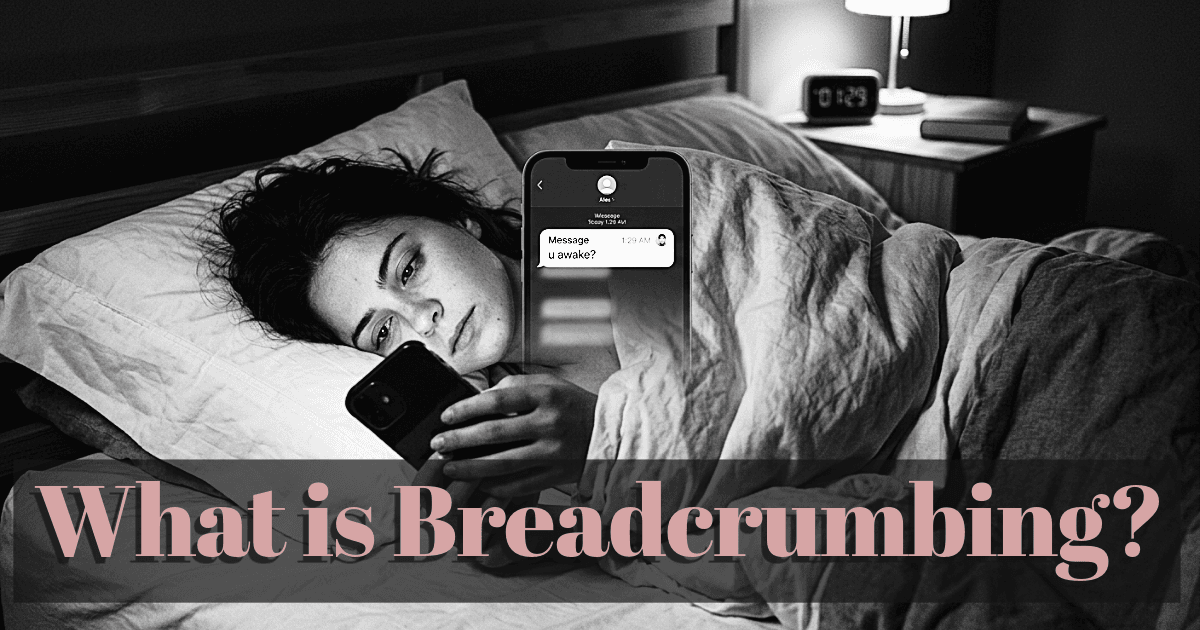
He only reaches out at night with“Wish you were here,” “Miss you.”
During the day, it’s silence. There’s no real effort to connect—just convenience.
Example 2.
The Future Faker
He talks about trips you’ll take together and things you’ll do “someday.”
Those plans never happened, though. It’s all talk, no follow-through.
Example 3.
The Social Media Watcher
He doesn’t text you often, but he watches all your stories, likes all your social media posts, and occasionally reacts. It keeps you wondering:
“Why is he still watching if he doesn’t want me?”
Example 4.
The On and Off Ex
Every time you start healing, he comes back with sentiments like, “I’ve been thinking about you.” or “I made a mistake.” But nothing actually changes.
Why Do People Breadcrumb?
This part matters—because it helps you stop blaming yourself.
According to Medical News Today, breadcrumbing has become increasingly common in modern dating, especially with the rise of digital communication.
Breadcrumbing happens for a few reasons:
He wants attention without commitment
He enjoys validation, emotional access, and knowing you’re still there – but he doesn’t want the responsibility.
He's emotionally unavailable
He may avoid intimacy, fear commitment, or struggle with consistency. Because of that, he keeps things surface-level.
He likes having options
Breadcrumbing often happens when someone isn’t fully invested, is dating multiple people, or wants to keep you as a backup.
That’s hard to hear, but it’s honest.
Control & ego issues
For some, it’s about feeling wanted, staying in control, and knowing he can come back anytime. That dynamic can keep you stuck.
The Emotional Impact of Breadcrumbing
Breadcrumbing doesn’t just waste your time; it affects how you see yourself. Over time, it can lead to:
- Lower self-worth
- Increased anxiety
- Difficulty trusting your instincts
- Emotional dependency
Mental health resource, Verywell Mind, explains that breadcrumbing can gradually lower a person’s expectations for consistency and emotional availability in relationships.
You might start believing that you’re asking for too much, but the truth is that wanting consistency, effort, and clarity isn’t asking for too much; it’s just the baseline.
If you take one thing from this, let it be this:
Confusion is not a sign of love. Real connection doesn’t leave you guessing, waiting, and overanalyzing. It feels clear, steady, and mutual.
You don’t need to prove your worth to someone who only shows up halfway, and there is nothing powerful about holding on to crumbs.
The power is in choosing yourself – even when it’s uncomfortable.